Cabin class primer: economy to first
What economy, premium economy, business, and first usually change, and how to read those cabins on a schematic.
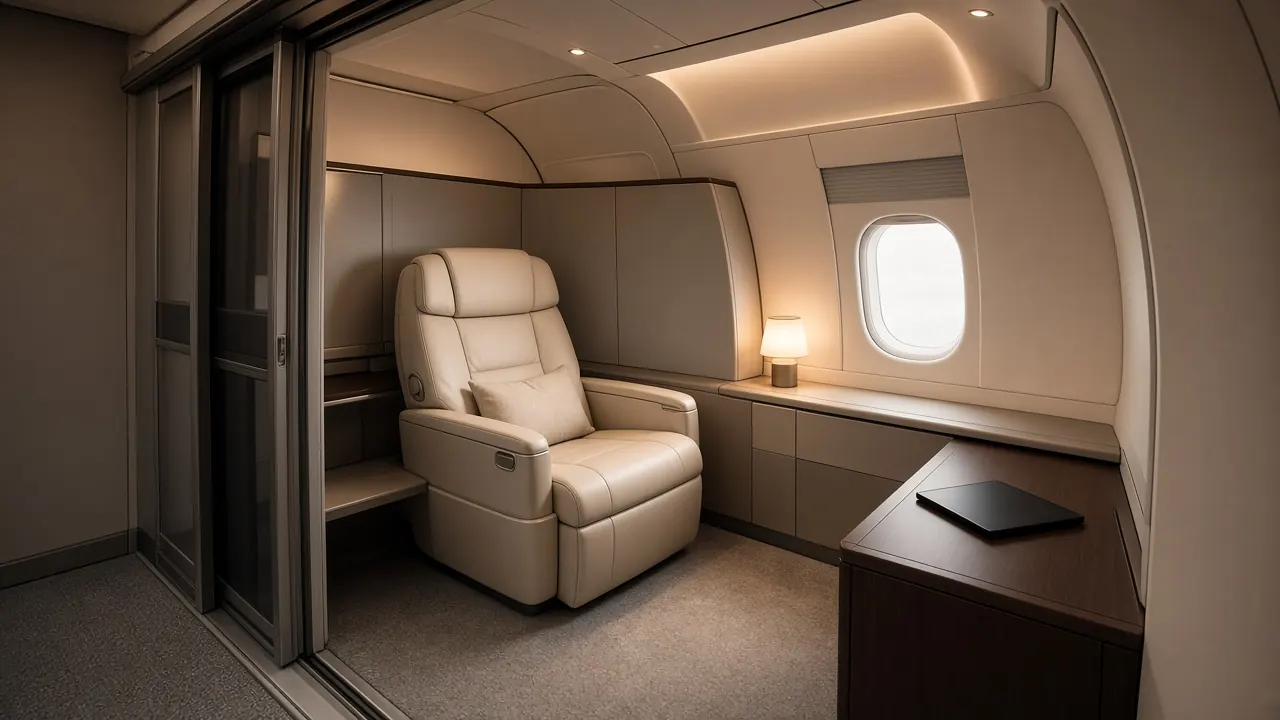
Airlines sell cabin classes that bundle a seat, a service style, and sometimes baggage or an earlier boarding group. One domestic first cabin is a recliner and a bigger meal. This primer is original editorial orientation for reading Pick Your Row schematics. It is not a fare rule book, and it is not a ranking of airlines. Use it to know which questions to ask the map, then buy the seat from the airline.
Economy, often sold as the main cabin, is the densest cabin on most aircraft. A typical single aisle jet shows three seats, an aisle, and three seats. A typical wide body main cabin shows three, an aisle, three, an aisle, and three. Exit rows and some bulkheads may add space inside that same class without changing the fare family name. A paid preferred seat is often ordinary pitch closer to the door, or an aisle people like, not a new seat model. If you only keep one economy habit, read the symbols around the letter before you pay for it.
Premium economy usually sits between business and economy on long haul aircraft. Travelers often get more pitch, a bit more width, a defined cabin ahead of the main cabin, and sometimes a stronger meal or a baggage allowance. You are still typically in a row with other people, not in a private lie flat suite. Compare it with a strong economy exit row before you pay, and only if you are allowed to sit in that exit. Our premium economy tips page stays on that money question. Product names differ by airline, and a curtain on a short flight is not the same cabin as a dedicated long haul premium seat.
Business class is a family of products, not one chair. On long haul jets it is often a lie flat or a deep recline seat with more personal space. Many newer cabins give every seat a path to the aisle, while older ones still leave a seat that must climb over a neighbor. On short flights, business can mean the middle seat blocked in an economy shell, or a larger recliner at the front of a single aisle jet. Real suite angles, privacy doors, and center seats without a window are more specific than our schematic.
First class is rarer than the word on a boarding pass suggests. On many long haul airlines it has been folded into a flagship business cabin, so the most premium seat you can buy is called business even when the seat itself is a suite. Where first still exists as its own cabin, treat it as the most forward, lowest density block on the schematic. Domestic first in the United States is often a different idea: a small recliner cabin on a single aisle jet, with service that looks generous beside economy and modest beside an international suite.
A downgrade is a consumer question, separate from which seat looked comfortable on a map. If you are moved to a lower cabin on a flight covered by European air passenger rules, official guidance describes reimbursement tied to flight distance. The Your Europe page linked below is the public summary to read, rather than a social media screenshot of a percentage. U.S. DOT Fly Rights is the public overview on the American side, and it is not the same regulation.
Industry evacuation education, linked below, tells passengers to follow crew instructions and to leave bags behind. Exit seat rules still attach to the exit seat, not to the cabin brand printed on your ticket. A premium fare does not exempt you from an exit briefing if you selected an exit seat, and it does not let a child occupy a seat the rule forbids. Exit row tips is the practical page. The federal text for U.S. part 121 operations is in the sources.
How to use our maps when you are choosing a cabin rather than only a letter: find the cabin block first, then note exits, lavatories, galleys, and bulkheads inside it. A strong letter next to a galley can sleep worse than a calmer letter farther from the service zone, even in business. Scores are opinions, explained in how Pick Your Row scores work. The methodology page separates those opinions from regulatory facts.
If the aircraft swaps, the class you bought can change shape without changing its name. A wide body business cabin can be replaced by a single aisle recliner product on the same flight number. A premium economy seat can disappear because the replacement jet does not have that cabin. Reopen the seat map as soon as the airline email arrives. Confirm you are still in the cabin you paid for, and ask about a refund or a reroute if a paid feature is gone.
FAQ
Is premium economy the same as an extra legroom seat in economy?
Usually no. Premium economy is typically its own cabin, often with more width and pitch, sitting ahead of the main cabin on long haul jets. An extra legroom seat is often an exit row or a bulkhead still inside economy, sometimes with assist rules and bag limits. The prices can look similar on a small screen, so open the map and read the product name before you pay.
Is business class always a lie flat bed?
No. On many long haul aircraft, business means a lie flat or a deep recline seat, and some of those seats have a door. On short flights, business can be a larger recliner or an economy seat with an empty middle. The word on the ticket is not the geometry, so check the aircraft and the airline description rather than assuming our drawing shows every suite angle.
What is the difference between domestic first and long haul first?
Domestic first, especially on single aisle jets in the United States, is often a small recliner cabin with stronger service than economy. Long haul first, where airlines still sell it, is usually a low density cabin at the front, often with suite seats. Many carriers no longer sell a separate long haul first product and put that space into business. Compare the route and the aircraft, not only the word first.
What can I do if the airline moves me to a lower cabin?
Treat that as a downgrade, not as a complaint that the map looked nicer yesterday. European consumer guidance describes reimbursement on covered flights, with the outcome tied to distance, and U.S. rules are a different system. Start with the official page for the itinerary, then talk to the operating airline with your receipt and original cabin. Wanting a quieter seat in the same cabin is a separate request.
Do exit row rules apply only in economy?
They apply to exit seats, wherever the airline places those seats. A premium ticket does not erase the duty if your seat is the exit seat. On U.S. part 121 flights the federal criteria include a minimum age and the ability to assist, and an adult caring for a small child may be refused. If you cannot perform the functions, choose another row, because crew can move you in any cabin.
How should I read a schematic when I am choosing a cabin?
Find the cabin block first, then the exits, galleys, lavatories, and bulkheads inside it. A good letter beside a noisy galley can be a worse sleep seat than a calmer letter in the same cabin. Use our best seats list as an opinionated shortlist, then confirm the live product on the airline site. Class names move with the aircraft, so the symbols on your flight are the ones that count.
Sources and references
Outbound links to authoritative public pages. Regulatory and consumer-rights material is fact; our seat scores remain editorial. See also the Methodology & sources page.
- Your Europe — Air passenger rights . Official EU consumer summary of Regulation (EC) No 261/2004 rights (delays, cancellations, denied boarding, downgrades).
- U.S. eCFR — 14 CFR § 121.585 Exit seating . Federal rule defining exit seats and passenger suitability criteria for U.S. part 121 carriers (facts; not our editorial score).
- IATA — Save a Life, Not a Bag (evacuation safety) . Industry passenger education on evacuation behavior (leave bags, follow crew). Supported publicly by FAA/EASA messaging.
- U.S. DOT — Fly Rights . U.S. Department of Transportation aviation consumer protection overview for passengers.
- EASA — EU Air Passenger Rights (European Commission) . EASA topic page pointing passengers to official EU air passenger rights managed by the European Commission.
Browse airline seat maps Methodology More guides
Related guides
- Exit row tips before you select. What exit row seats usually mean for space, rules, storage, and who should skip them.
- Bulkhead seats: pros and cons. First row cabin seats explained, with bassinet notes, foot space, and common surprises.
- Aisle vs window: how to choose. A practical comparison of aisle and window seats for rest, access, views, and when a middle seat is still fine.
- How Pick Your Row scores work. What our 1–10 editorial seat scores mean, which tags we apply, how we separate editorial opinions from regulatory facts, and why scores are planning tools — not guarantees.